Preface
This book was not planned. It grew out of a series of precise analytical inquiries conducted in May 2026, as the Akuapem Traditional Area prepared to mark the bicentennial of the Battle of Katamanso — the military event from which the Akuapem Odwira Festival, and much of the state’s modern constitutional order, directly derives.
The questions that drove the enquiry were institutional, not merely historical. As a senior customary law practitioner and member of the Judicial Committee of the Kronti Division, the author has a professional interest in understanding exactly what the Kronti Division did at Katamanso on 7 August 1826, under what title its commander then served, and how the constitutional arrangements that emerged from that battle shaped the division’s role for the two centuries that followed.
What the enquiry revealed was richer — and in places, more contested — than the standard bicentennial narrative suggests. The documentary record, the missionary archives, the scholarly literature, and the oral traditions encoded in the Ofie TV compilation of Okuapeman Global do not always agree. Where they conflict, this work says so plainly. Where the evidence is strong, it says so. Where inference has been employed in place of evidence, that too is marked explicitly.
A particular effort has been made to verify or challenge claims that circulate as settled history. The assertion that the Ga people captured the Ashanti Golden Stool at Katamanso does not survive critical scrutiny and is addressed at length in Chapter Five. The identification of the Adonten No. 1 Hene at the time of the battle as Nana Kofi Kra (Boakye) draws on institutional oral tradition within the Kronti Division and awaits external corroboration via the Basel Mission archive in Switzerland.
This is a working history: precise where the evidence permits, candid where it does not, and always in service of institutional truth rather than institutional comfort.
Barima Kwasi Osae Kwabi
Senior Customary Law Practitioner
Member, Judicial Committee of the Kronti Division, Akuapem Traditional Area
Akropong-Akuapem, May 2026
The Gold Coast Before the Storm
Ashanti Expansion and the Stakes of 1826
By the opening decades of the nineteenth century, the Gold Coast’s political map was under a pressure that older arrangements could not long contain. The Ashanti Confederacy — forged in the late seventeenth century, consolidated under Osei Tutu, and extended dramatically under Opoku Ware I — had become the dominant power of the forest zone and was pressing relentlessly southward toward the Atlantic littoral. The logic of this pressure was mercantile and strategic in equal measure: control of the coastal corridors to the European forts at Cape Coast, Christiansborg, and Anomabo meant control of firearms, powder, and the leverage those conferred in the interior.
For the smaller states of the near-coast and the ridge, Ashanti expansion was experienced as a gravitational force — sometimes as tributary obligation, sometimes as military subjugation, always as a recalibration of the price of independence. The Ashanti campaigns of 1811 and 1814 to 1816 had made the calculation brutally clear. In 1811, Ashanti forces swept through Fante territory with a decisiveness that shocked both coastal states and their European trading partners.
The event that made a decisive allied response inevitable was the Battle of Nsamankow in January 1824. Sir Charles MacCarthy, the British Governor of the Gold Coast, led a force against an Ashanti army and was killed in action. His skull, it was reported, was subsequently fashioned into a ceremonial drinking vessel for Asantehene Osei Yaw Akoto. The psychological and political consequences were profound: it demonstrated that the British were not militarily invincible, emboldened Osei Yaw Akoto to press the southern campaign with renewed confidence, and simultaneously galvanised the coastal and near-coastal allies into building a coalition adequate to breaking Ashanti power permanently.
Into this charged environment, the Akuapem ridge-state occupied a position of peculiar exposure. Geographically, the Akuapem hills rise sharply from the Accra plains — defensible, certainly, but not impregnable. Economically, the Akuapem towns had developed modest but real prosperity through trade and their position at the intersection of northern forest and southern coastal routes. By 1826 the Akuapem leadership had concluded that the arithmetic of regional power was approaching a moment of resolution. They committed to the coalition not as reluctant auxiliaries but as belligerents with a deep stake in the outcome.
It is worth pausing to appreciate what the Ashanti Confederacy represented as a military organisation by 1826. The army that Osei Yaw Akoto brought south — approximately 40,000 fighting men in the main force, supported by reserves of 8,000 and a royal guard of 2,000 — was not a tribal levy. It was a structured, experienced force that had conducted sustained campaigns across forest and savanna, maintained sophisticated supply chains over long distances, and refined a body of military doctrine across more than a century of expansion.
Against this, the allied coalition brought something different: thirteen parties who had found, in the Ashanti threat, sufficient common cause to subordinate their mutual rivalries. British and Danish forces brought European weapons technology and, critically, Congreve rockets. Ga, Fante, Akyem, Akwamu, Denkyira, and Akuapem forces brought local military knowledge, terrain-calibrated formations, and the motivated commitment of peoples fighting for their own survival. It was an extraordinary coalition assembled around the single proposition that Ashanti imperial reach must be broken on the plains of Dodowa — or not at all.
Ninety Years on the Ridge
The Akuapem State and Its Divisions in 1826
The Akuapem state in 1826 was approximately ninety-three years old, measured from the great revolt against Akwamu overlordship that constitutes its founding moment. That revolt — consummated around 1733 when the Akuapem people threw off the tyranny of Akwamuhene Nana Ansa Sasraku — was itself a coalition-building exercise of the first order, a fact that would prove constitutionally important nearly a century later at Katamanso.
Before the 1733 campaign against Akwamu, the man who would become the founding Adonten No. 1 — Nana Offei Kwasi Agyemang, the Gyakiti warlord of the Aduana clan — summoned all the fetish priests, their subjects, and their servants to a great council. Together with the Gyakiti chief and the Akan-Kamena chief, they swore a unified oath, binding the deities and the warriors to a single covenant of war. This was not merely a military compact. It was a theological act: it made the forthcoming campaign a joint enterprise of human warriors and divine forces, with all parties mutually accountable. That political technology — the war covenant sworn before spiritual witnesses — is the direct template from which the Odwira covenant of 1826 would later be fashioned.
The revolt succeeded. The Akuapem captured 150 guns and over 300 prisoners from the Akwamu forces. These weapons were redistributed and serviced by divisional gunsmiths, the atuduro adwumayefo, attached to the Kronti and Adonten divisions. A new state was born — and with it, a set of institutional arrangements that matured over the next ninety years into the most developed military and political structure on the Akuapem ridge.
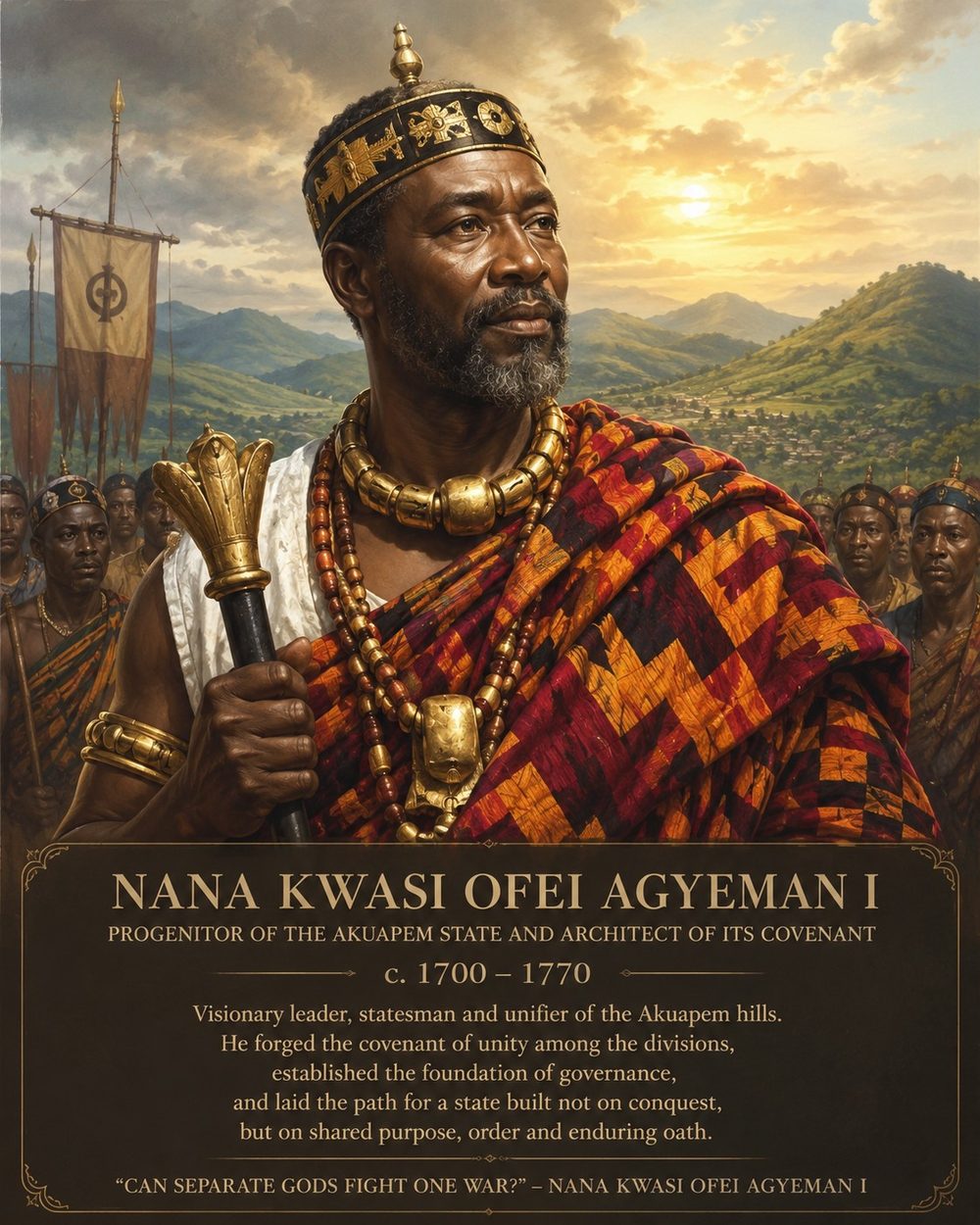 Artist’s reconstruction
The Five Divisions
The Akuapem state’s internal organisation by 1826 followed the Akan divisional system adapted to the specific ethnic and geographic configuration of the ridge. Five principal divisions served the Okuapehene: the Adonten (vanguard), the Nifa (right wing), the Benkum (left wing), the Gyase (bodyguard and household), and the Kronti. Each division was headed by a chief with a defined constitutional position and specific military and ceremonial functions.
The Akuapem case is importantly distinguished from purely Asante-model states by the state’s multi-ethnic composition. The Kyerepong, Larteh, and Okere are Guan-speaking peoples whose incorporation into the Akuapem political community preceded the Twi-speaking nucleus at Akropong. This multi-ethnic reality meant the divisional system served not merely as military organisation but as a mechanism for integrating diverse communities into a single constitutional order, with each chief’s position defined by both his military function and his relationship to the Ofori Kuma Stool.
The Adonten No. 1: The Kronti Stool Before 1934
From the founding of the Akuapem state until 1934, the chief of the Kronti Division held the title Adonten No. 1 — not Krontihene. The redesignation to Krontihene was effected in 1934 by Nana Ofori Kuma, formalising the Kronti as second-in-command to the Okuapehene and acting commander-in-chief in his absence. This means that at the time of the Battle of Katamanso on 7 August 1826, the commander of the Kronti Division held the constitutional title Adonten No. 1 Hene.
Institutional oral tradition within the Kronti Division identifies the incumbent Adonten No. 1 Hene at the time of Katamanso as Nana Kofi Kra, also known as Boakye. The external documentary record — principally the Basel Mission archive series D-01.01 from 1829 onwards — has not yet been systematically examined to corroborate this attribution. The Basel Mission entered Akropong in 1835, only nine years after the battle, and Andreas Riis’s early correspondence records conversations with people who lived through the Katamanso campaign. A dedicated archival inquiry in Basel remains the essential next step for confirming this stool-holder’s name with external evidentiary support.
What is structurally certain, even in the absence of that corroboration, is the role the Adonten No. 1 played. He was the senior military commander of the state’s most powerful division — heir to Nana Offei Kwasi Agyemang’s tradition of covenant-based warfare, custodian of the Aduana dog-and-fire emblem, and institutional master of the artisanal and ritual logistics that made Akuapem military campaigns operationally effective.
The Fall of Nana Kofi Kra: Betrayal, Exile, and the Kye Krotia
The institutional record of the Kronti Division does not end with Katamanso. The oral history preserved by the Krontihene’s palace and conveyed in the interview of 11 May 2026 contains a further chapter in the career of Nana Kofi Kra (Boakye) that is as constitutionally significant as his role at the battle itself — and considerably more troubling.
According to this testimony, Nana Kofi Kra at some point after Katamanso attempted to align with the Ashanti in matters concerning the Odosu. The precise nature of this alignment is not fully disclosed in the surviving oral record: whether it involved returning the Odosu to Ashanti custody, negotiating over the deity’s status under Akuapem stewardship, or seeking Ashanti backing to consolidate the Kronti Division’s authority over the Odosu at the expense of the Okuapehene’s broader state control. What the record is unambiguous about is the characterisation of the act: it was a betrayal of the Okuapehene.
The motivation, while not stated explicitly, is not difficult to reconstruct from the institutional logic of the period. The Odosu was the most spiritually potent object in the Akuapem state. The Okuapehene’s decision in 1826 to place it at Apirede under the Mankrado rather than under the Kronti’s direct custody was a deliberate constitutional act to prevent any single division from monopolising the war deity. If Nana Kofi Kra sought Ashanti engagement over the Odosu, one plausible reading is that he was attempting to leverage external recognition of a Kronti custodial claim that Nana Addo Dankwa I had specifically refused to grant. That would make the betrayal not merely personal disloyalty but a structural constitutional challenge to the post-1826 settlement.
The punishment, as transmitted through institutional oral memory, is recorded in two forms that are not fully reconciled and must be presented as such. The oral tradition holds that Nana Kofi Kra was beheaded at a place known as the Kye Krotia, where annual libation is poured and other forms of commemoration are carried out in perpetuity in remembrance of the act. Palace records, however, state that he was exiled in 1845. The destination of the exile is unknown. Whether it was self-imposed or compelled by the state is equally unresolved.
These two accounts — beheading and exile — are not necessarily contradictory, though they cannot be collapsed into one. Several readings are possible. The ‘beheading’ at the Kye Krotia may represent a ritual or symbolic execution of his legacy rather than a physical killing, with the actual punishment being exile and the Kye Krotia site consecrated thereafter as the locus of annual condemnation. Alternatively, he may have been condemned to death under Akan customary law for the gravity of the betrayal — which would have warranted capital punishment — with the sentence subsequently commuted to exile, leaving the Kye Krotia as the site of the symbolic execution. A third possibility is that the two traditions encode the same event from different institutional vantage points: the Kronti Division’s internal memory and the palace written record.
Palace records have it that he was exiled in 1845. To where exactly, we do not know. Was it self-exile or forced exile? There is no record that can answer these questions. The punishment in the oral tradition is that he was beheaded at the Kye Krotia, where annual libation pouring and other forms of commemoration are carried out in remembrance of that atrocious act.
The Kye Krotia is a living institution. The annual libation poured there is not antiquarian commemoration. It is a ritual act that keeps the memory of the betrayal present in the constitutional life of the Kronti Division — a permanent warning, encoded in ceremony, that the Odosu covenant admits no negotiation with external powers. In this sense the Kye Krotia rite and the Thursday night Ademi rite are two sides of the same constitutional coin: one renews the covenant in its pure form, the other commemorates the cost of violating it.
The 1845 exile date carries a further significance that has gone unnoticed in the existing literature. By 1845 the Basel Mission had been resident in Akropong for a decade. The 24 West Indian missionaries had arrived in 1843 — the same year in which the first Basel primary school in Ghana was established on land allocated during Nana Kofi Kra’s tenure as Adonten No. 1. If the exile occurred in 1845, the missionary community was present and active in Akropong during the entire period of the betrayal, the proceedings against Nana Kofi Kra, and his removal. The Basel Mission archive almost certainly contains contemporary correspondence from these years. That correspondence is unlikely to mention Nana Kofi Kra by name or to describe his downfall — for reasons addressed in the next section — but it may contain circumstantial evidence: unusual political tension, a disruption in the Kronti’s ceremonial calendar, a change in who the missionaries encountered as the division’s senior representative.
The Okuapehene in 1826
Nana Addo Dankwa I, the nineteenth Okuapehene, reigned from 1811 to 1835. By 1826, he was a ruler of fifteen years’ experience who had navigated the full complexity of the Ashanti threat during the years of maximum southern pressure. His decision to commit Akuapem forces fully to the Katamanso coalition was a sovereign act based on a clear reading of the state’s existential interests. His subsequent decisions in the aftermath of the battle — the institution of Odwira on 16 October 1826, and the deliberate placement of the captured Odosu at Apirede rather than at Akropong — reveal a constitutionally sophisticated mind working at the height of its powers.
Seven August 1826
The Battle of Katamanso
The Battle of Katamanso was fought on the flat plains near Dodowa, in what is today the Greater Accra Region of Ghana, on 7 August 1826. It lasted nine hours — from six o’clock in the morning until three in the afternoon — and it ended in the most complete military defeat the Ashanti Confederacy had suffered since its founding. Understanding what happened in those nine hours, and why the outcome was what it was, is essential to understanding everything that followed.
Order of Battle
The Ashanti army that marched south under Asantehene Osei Yaw Akoto was formidable by any measure. Approximately 40,000 fighting men constituted the main force, supported by reserves of 8,000 and a royal guard of 2,000. This was a full national mobilisation, not an expeditionary raid. Osei Yaw Akoto sought a definitive resolution of the southern question, having been emboldened by the MacCarthy victory of 1824.
Against this force, the allied coalition deployed the combined resources of thirteen allied parties. British forces under Captain Ricketts and Danish-allied forces brought European military technology. Ga-Adangbe warriors from the Accra plains brought intimate knowledge of local terrain. Fante, Akyem, Akwamu, Denkyira, and Akuapem forces each contributed divisions structured according to their own military traditions. In aggregate, the coalition was substantially outnumbered. What it possessed — and what would prove decisive — was a convergence of self-interests, professional coordination, and a weapons asymmetry the Ashanti could not anticipate.
The Nine Hours
The Ashanti forces held their position with extraordinary discipline for the full nine hours of the engagement. This was not an army that broke at first contact or wilted under sustained fire. It had faced musket volleys on previous campaigns and knew how to absorb casualties while maintaining formation. The allied forces, including the Akuapem divisions under the Adonten No. 1, pressed the engagement throughout the morning and into the afternoon without achieving a decisive break.
What changed the battle’s outcome was the deployment of Congreve rockets by the British contingent. Developed by Colonel William Congreve and widely used in the Napoleonic Wars, these rocket-propelled incendiary weapons had never been encountered by Ashanti forces. Their effect was simultaneously physical and psychological. Warriors who had trained to hold steady under musket fire — whose courage had been tested across multiple campaigns — had no cognitive framework for weapons that arrived from an unexpected angle with a distinctive trajectory and that exploded on impact.
The Ashanti formations that had held all morning broke in the early afternoon. Between five thousand and six thousand Ashanti warriors died at Katamanso — a figure representing a catastrophic national loss that immediately paralysed Ashanti capacity for further southward military operations.
The Significance of the Coalition’s Composition
One detail in the order of battle deserves specific emphasis: the allied coalition at Katamanso included Akwamu forces — the very people against whose tyranny the Akuapem state had been founded in 1733. By 1826, shared interest in resisting Ashanti dominance had produced a coalition that included former adversaries fighting side by side. This is the mature expression of the political technology that the Akan confederation tradition had developed: the capacity to form, break, and reform alliances based on the current configuration of interests, without allowing historical enmities to permanently foreclose cooperation when circumstances demand it.
The Kuronti at War
Command, Logistics, and Ritual
The Kronti Division’s military function at Katamanso cannot be understood through the single lens of battlefield tactics. The Ofie TV compilation of Okuapeman Global oral histories, together with KNUST and AJOL scholarly records, presents a picture of threefold military function: command and the confiscation of enemy regalia; artisanal logistics; and fetish and ritual deployment. All three were operational at Katamanso.
1. Command and the Capture of Regalia
The institutional pattern of the Kronti Division at war — established by Nana Offei Kwasi Agyemang himself — was not merely to defeat the enemy militarily but to capture and absorb enemy regalia as proof of power and as spiritual trophies that enhanced the division’s authority. The oral record is explicit: in an early war, the founding Adonten No. 1 confiscated an opponent’s regalia — including ceremonial fans used to honour senior chiefs. This pattern of regalia capture is not incidental; it is constitutive of the Kronti’s military identity.
The significance of this institutional pattern becomes fully legible at Katamanso. The capture of the Odosu — the Ashanti war deity and its attending regalia, together with the elderly priestess who tended to it — was not an accident of the battlefield. It was the expression of a military tradition in which the Kronti’s commanders knew to seek specifically for enemy ritual objects at the moment of the enemy’s collapse. The Akuapem forces that pursued the broken Ashanti formations on the afternoon of 7 August 1826 were following a doctrine of regalia capture the division had practised for nearly a century.
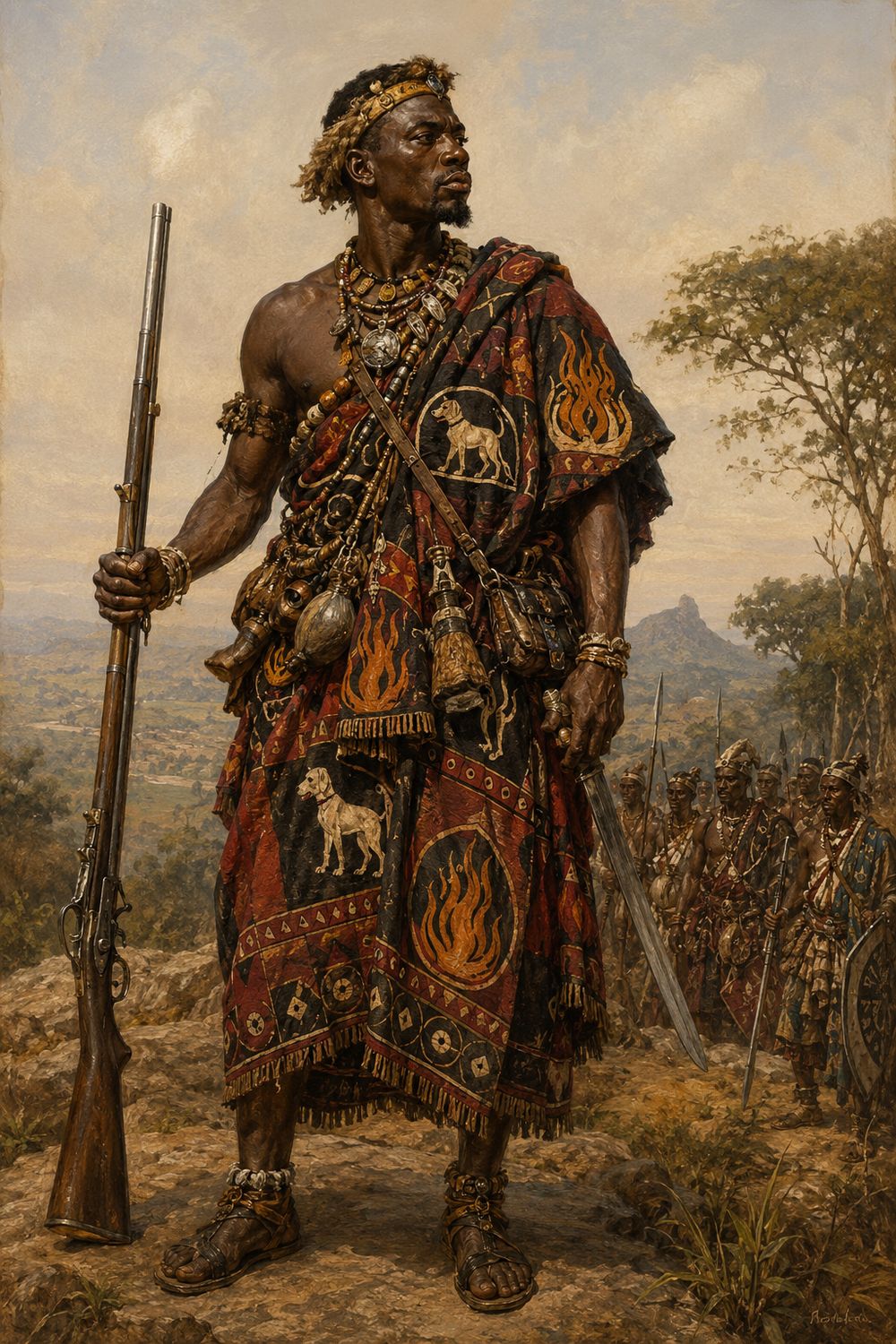 Artist’s reconstruction
2. Artisanal Logistics
The Kronti’s wartime function extended well beyond the command of fighting formations. The division managed a supply chain that included food provisioning, armament maintenance and redistribution, textile and emblem production, and the manufacture and care of ceremonial instruments. The oral record preserves a specific detail about food provisioning: every warrior was to carry enough fried maize powder (kyekyire) and fried maize in their food bag — the carbohydrate ration that made sustained campaigns across forest and savanna viable.
The armament dimension of logistics was equally significant. After the founding war against Akwamu, the Akuapem had captured 150 guns; these were redistributed and maintained by hereditary gunsmiths — atuduro adwumayefo — whose institutional loyalty was attached to the Kronti and Adonten stools. By 1826, this hereditary craft tradition had ninety-three years of accumulated expertise. In a coalition battle where musket fire was the primary weapon for most of the nine-hour engagement, functional firearms maintenance was a direct combat multiplier.
The textile and emblem production associated with the Kronti — the Aduana dog-and-fire emblems, the adinkra cloths, the woven regalia used in formal procession — were produced by craft guilds with hereditary attachment to the division. In the Akan military tradition, the visual and symbolic presentation of a fighting force was an element of spiritual and psychological preparation for war. The guilds that produced these objects were therefore part of the division’s military apparatus, not merely its cultural adornment.
3. Fetish and Ritual Deployment
Akuapem warfare was a theological undertaking from first to last. Before any major campaign, the Kronti’s commanders depended on ritual specialists for the consecration of the war covenant, the consultation of oracles before deployment, and the activation of spiritual protections during battle. The asafohenfo — the war captains serving under the Kronti’s command structure — were simultaneously military officers and ritual officials. Their authority over their fighting men derived from both demonstrated battlefield competence and their relationship to the division’s spiritual protective apparatus. This dual authority was not a contradiction; it was the operational form that Akuapem military culture had evolved for deploying effective force.
At Katamanso, this framework produced the result that has shaped Akuapem identity for two hundred years: the capture of the Odosu. That capture was understood, from the moment it occurred, as a spiritual victory — the absorption of an Ashanti war deity into the Akuapem spiritual order, the most consequential regalia capture in the division’s history.
The Capture of the Odosu
Victory on Two Planes
Of all the events at Katamanso on 7 August 1826, none has shaped Akuapem identity more profoundly than the capture of the sacred war complex subsequently venerated under the name Odosu. The scholarly record and the living institutional tradition do not describe this capture in identical terms, and both deserve to be stated with precision rather than collapsed into a single narrative.
M. A. Kwamena-Poh, writing in the ‘Encyclopaedia Africana’, records that Nana Addo Dankwa I captured from the Ashanti what he specifically designates the ‘Odwira Apafram’ — the sacred ceremonial regalia that the Ashanti used to celebrate their own annual Odwira or Yam Festival. Kwamena-Poh’s entry in the ‘Akuapem Handbook’ (David Brokensha, ed., Ghana Publishing Corporation, 1972, p. 45) adds a further and more charged component: the head of the late Governor Sir Charles MacCarthy, which the Ashanti had taken at the Battle of Nsamankow in January 1824 and which subsequently fell into Akuapem hands at Katamanso. Akuapemfo interviewed by Ernestina Afriyie confirmed that the Odosu is understood to be composed of the skulls of great enemies defeated in war, with MacCarthy’s head named as a specific component.
Popular and institutional tradition — including the 2024 Akuapem Odwira Festival narrative and the oral account preserved by the Apasâmakahene Nana Addo Birinkorang — does not disaggregate the captured items but refers to the whole ensemble under the single designation ‘Odosu.’ The Odosu of Akuapem oral tradition is therefore the composite name for what Kwamena-Poh’s scholarship itemises as the Odwira Apafram and MacCarthy’s head: different descriptions of a single sacred bundle, viewed from the scholarly and the institutional angles respectively. This work uses ‘Odosu’ throughout as the living institutional designation while acknowledging the distinction the scholarly record preserves.
The oral account of Nana Addo Birinkorang further specifies a precise sequence that the standard narrative of a single founding date does not capture. The Akuapem warriors returned from Katamanso on 11 August 1826. On 16 August, under the Mpeni tree in Akropong, the Oman held the spiritual consultations with the Priestess on the terms governing the Odosu’s residence in the state. On 25 August 1826, the purification rites were performed and Odwira was formally instituted as an annual festival. An alternative tradition, cited by Afriyie from a University of Education, Winneba thesis, gives the date of formal institution as 16 October 1826. Both dates are recorded here without false resolution: the August date aligns with the Apasâmakahene oral record; the October date may reflect the first public celebration rather than the private spiritual institution under the Mpeni tree. The gap between them — approximately nine weeks — is exactly the time required for purification protocols before a major public ceremony in Akan practice, which makes both dates coherent within a single sequence rather than contradictory.
The Afriyie reconstruction, drawing on Kwamena-Poh and the Apasâmakahene oral tradition, provides the most precise scholarly account currently available:
Among the war trophies captured by the Akuapem forces at Katamanso in 1826 were the Odwira Apafram — the Asante’s sacred Odwira ceremonial regalia — and the head of the late Governor Sir Charles MacCarthy, which the Ashanti had taken at Nsamankow in 1824. These items, subsequently venerated collectively under the designation Odosu, became the sacred foundation of the annual Akuapem Odwira Festival, formally instituted at Akropong in August–October 1826.
The captor is identified in oral tradition as a native of Obosomase, an Akuapem town. The Akuapem Traditional Council’s institutional records hold the definitive determination of which division Obosomase belongs to, which would in turn identify which division claims primary institutional credit for the capture. What is certain is that the capture was an Akuapem act, committed in the pursuit phase of the battle when the Ashanti formations had broken, and that it was committed by someone with the trained awareness to recognise what the Odwira Apafram bundle represented and to secure it along with the Priestess who could explain its terms.
The Elderly Priestess and the Covenant
The capture of the priestess alongside the Odosu is of critical importance. The Odosu was not merely an object — it was a deity in material form, attended by a ritual specialist whose knowledge was inseparable from the object’s spiritual function. In capturing both the regalia and its attending priestess, the Akuapem captor secured not only the war deity’s physical form but the knowledge required to engage with it correctly. The priestess’s declaration to the Okuapehene transforms what might have been a trophy into a covenant. The Odosu does not simply sit in Akropong as proof of military victory; it becomes the spiritual centre of an annual obligation the entire state must fulfil.
The Golden Stool Claim: A Critical Assessment
Alongside the Odosu account, a parallel tradition holds that the Ga people captured the Ashanti Golden Stool at Katamanso. This claim requires direct challenge, because it does not survive historical scrutiny on any of the available evidential tests.
The Sika Dwa Kofi — the Golden Stool of Asante — is the supreme spiritual embodiment of Ashanti nationhood. It was maintained at Kumasi and was not transported on southern military campaigns. The most telling evidence comes from 1900, when British Governor Sir Frederick Hodgson’s demand to sit on the Golden Stool triggered the Yaa Asantewaa War. Despite an extended British military presence at Kumasi, the Ashanti successfully concealed the Stool throughout that conflict. It was not captured. A nation that would fight a full-scale war to prevent a seated administrator from touching their sacred stool did not bring it on a southern military campaign.
What the Ga forces may have captured was a war stool or war chest: campaign regalia consecrated for the specific expedition, of genuine spiritual weight, but not the Sika Dwa Kofi itself. This misidentification is not unusual in oral tradition. Captured war regalia of significant spiritual weight are frequently described in increasingly exalted terms by the captors as the generations pass. This does not impugn the Ga forces’ genuine achievement at Katamanso — it simply places the claim in accurate historical context.
More importantly: the Akuapem achievement at Katamanso — the capture of the Odosu, an Ashanti war deity with its attending priestess, subsequently installed as the spiritual foundation of a festival that has survived two centuries — requires no inflation. It is achievement enough on its own terms.
The Constitutional Harvest
Odwira, Stool Distribution, and the Bond of 1831
Military victory produces a moment of extraordinary political opportunity. What Nana Addo Dankwa I did with the opportunity of 7 August 1826 — in the seventy days between the battle and the institution of Odwira on 16 October 1826 — constitutes one of the most sophisticated acts of constitutional design in the Akuapem state’s history.
The Institution of Odwira
On 16 October 1826, the nineteenth Okuapehene formally instituted Odwira as an annual festival of purification, thanksgiving, and covenant renewal. In doing so, he replaced the older Guan Ohum festival that the Akuapem had previously celebrated with a new rite that was simultaneously a military memorial, a spiritual covenant, and a constitutional instrument.
As covenant, Odwira places all Akuapemfo under an annual obligation to the Odosu. The oguan kokoo sacrifice, performed by the Okuapehene on behalf of the whole state, is not a cultural formality. It is the annual payment on the covenant the priestess specified in 1826. Afriyie’s scholarship makes the point precisely:
Odwira is a covenant renewing festival that places all Akuapemfo (Akuapem people) under a covenant with the Odosu (a regalia).
This covenant theology explains why even Nana Addo Dankwa III, a professed Christian who reigned for thirty-five years, maintained the sacrifice annually without exception, declaring that it would never be the case that Odwira would not be celebrated in a given year. The festival is not a cultural preference that a Christian paramount can elect to set aside. It is a state obligation — the price of whatever protection and blessing the captured war deity extends to the Akuapem polity.
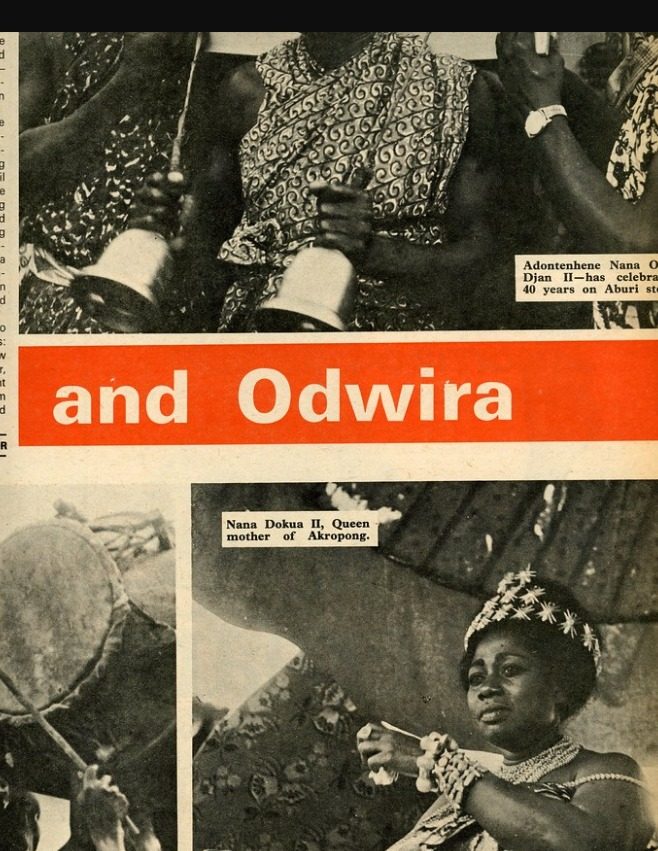
The Thursday Night Ademi Rite: The Covenant in Its Purest Form
What the published literature describes in outline, institutional oral testimony fills with precision. In an interview granted by the Krontihene and his elders at Akropong-Akuapem on 11 May 2026, the Thursday night rite of Odwira was described in terms that establish it as the most constitutionally consequential act of the entire festival week — and the most strictly guarded.
On Thursday night of every Odwira, the Odosu is moved from its location and carried to the Ademi stream. At the same time, the five divisional chiefs proceed to the abode of the sacred stools, and the entire company — Odosu, divisional chiefs, stool custodians, and state officials — converges at the Ademi stream for the renewal of allegiance to the Ofori Kuma stool and the other deities of the state. The rite is performed in the dead of night and its content is revealed to no one outside the inner circle of participants.
The enforcement of secrecy is absolute and carries the full weight of state authority. As the procession moves toward the Ademi, musketry fires and formal shouts go up — a proclamation rendered in a ceremonial phrase that translates approximately as: ‘We do not meet.’ This is not a warning in the modern sense. It is a constitutional declaration: anyone encountered on the path of the procession will be executed on the spot by the Abrafo, the state executioners. The musket fire is both signal and enforcement: it clears the route, announces the passage of the sacred, and makes the state’s jurisdictional claim over the night’s territory absolute.
On Thursday night of Odwira, there is renewal of allegiance by the five divisional chiefs to the Ofori Kuma stool and other deities at the Ademi. That ritual is performed in the dead of night and revealed to no one. When the movement of the stools and deities to the Ademi stream takes place, there are musketry fires and shouts signifying ‘we do not meet’ — and anyone caught will be executed on the spot.
The theological logic of the rite is precise. The Odosu — captured at Katamanso in 1826 and entrusted to Apirede for the rest of the year — is brought to the Ademi stream because moving water in Akan ritual theology is a site of purification, renewal, and spiritual concentration. The covenant is not merely remembered at the Ademi; it is re-enacted there, in the darkness, in the presence of the original war deity and the five divisional chiefs whose constitutional roles descend directly from the military structure that captured the Odosu two centuries ago. The five chiefs who kneel at the Ademi are, in the ritual frame, the institutional heirs of the commanders who stood on the plains of Dodowa on 7 August 1826.
The Krontihene’s role in this rite is therefore not ceremonial in the decorative sense. As the senior divisional chief and acting commander-in-chief of the state, the Krontihene is the presiding military authority in the nocturnal procession — heir to the Adonten No. 1 who commanded the Aduana warriors at Katamanso, and custodian of the institutional memory that the Thursday night Ademi rite keeps alive in its most concentrated form. The musket fire that accompanies the procession is not merely traditional noise. It is the sound of the same weapons tradition that broke the Ashanti formations on 7 August 1826, now repurposed as the guardian of the covenant those weapons made possible.
The Distribution of the Odosu: A Constitutional Masterstroke
The most revealing of Nana Addo Dankwa I’s post-battle decisions was the disposition of the Odosu. He did not place it at Akropong — the seat of the Okuapehene and the primary stool-house. He did not award custody to the division whose forces captured it. He entrusted the Odosu to Apirede, under the Mankrado — a deliberate distribution of spiritual capital across the state, specifically constructed to prevent any single division from monopolising the war deity’s power.
The annual Odwira procession is the constitutional consequence of this decision. Every September, the Odosu must travel from Apirede to Akropong. The Kronti Division escorts this procession. The Abrafo — the state executioners — cleanse the path at the Ademi mu river on Thursday night. The Odosu arrives at Akropong for the festival’s climax, then returns to Apirede. This annual movement is a re-enactment of the covenant, a demonstration of the state’s continued commitment to the terms set in 1826, and a reaffirmation of the Kronti’s role as military escort of the state’s most sacred object.
On the climactic Thursday evening, all five divisional chiefs proceed to the abode of the sacred stools to swear loyalty to the Ofori Kuma Stool — the central act of state cohesion, the annual renewal of the constitutional compact between the paramount and his divisional chiefs, embedded within the festival’s theological framework.
The Bond of 1831 and the Basel Mission
The military settlement of Katamanso required a formal political instrument to secure its consequences. That instrument was the Bond of 1831, negotiated by British Governor George Maclean. The Ashanti Confederacy formally renounced sovereign claims over the coastal and near-coastal states, including the Akuapem. This translated the military victory of 1826 into a recognised legal status: the Akuapem were no longer a tributary zone under Ashanti suzerainty but a polity whose independence had been acknowledged in formal treaty.
This was the political foundation that made the Basel Mission’s entry possible. Andreas Riis arrived in Akropong on 26 March 1835, hosted by the Okuapehene’s elder Nana Kwaw Kutruku. Nana Addo Dankwa I’s observation to Riis — that Christianity appeared in local eyes to be a religion for white people, and that converting the Akuapem would require dark-skinned missionaries — was a sovereign’s assessment of institutional fitness, made from the position of a chief whose state had demonstrated, nine years earlier, that its own spiritual and military institutions were adequate to defeating the largest army in West Africa.
Riis’s letter of 27 July 1836 records a further detail: Nana Addo Dankwa I refused a summons to Christiansborg by the Governor. A chief who had earned his sovereignty at Katamanso and secured it in treaty did not present himself on demand at a European fort. That refusal is the political consequence, expressed in a single act, of everything that had happened since August 1826.
Two Centuries of Consequence
Mission, Covenant, and the Bicentennial
The two centuries between 1826 and 2026 are, in the Akuapem context, a long argument between the covenant established at Katamanso and the competing institutional claims of the Basel Mission and its successors. That argument has never been resolved. What two centuries have demonstrated is that the covenant has proved more durable than any of its challengers anticipated.
The Missionary Encounter
The Basel Mission’s arrival in 1835 initiated what Cati Coe has called the dilemmas of culture — the deep tension between a mission enterprise that required converts to renounce their prior religious obligations and a state whose constitutional coherence was founded precisely on those obligations. The Odwira covenant was not a private religious preference that an individual convert could quietly abandon. It was a state obligation, annually renewed by the paramount on behalf of the whole community.
The mission records note that during periods of mission ascendancy, chiefs and queen mothers of many Akuapem towns did not attend the annual Odwira — testimony to how deeply the festival’s covenant theology had become a contested space. The recruitment of twenty-four West Indian missionaries from Jamaica and Antigua in 1843 — a direct consequence of Nana Addo Dankwa I’s observation to Riis — brought Christian witness of a different character to the ridge. But it did not dissolve the Odosu covenant. Two centuries on, Ernestina Afriyie’s contemporary missiological recommendation that converts in Akuapem require explicit deliverance and verbal renunciation of the Odosu covenant at conversion is the current chapter in this ongoing encounter.
The Kronti’s Enduring Constitutional Position
Through the missionary encounter, through colonial reorganisation, through independence, and into the twenty-first century, the Kronti Division’s constitutional position has remained defined by the institutional role it established at Katamanso. The 1934 redesignation — from Adonten No. 1 to Krontihene — formalised what was already operationally true: the Kronti was and is the second pillar of the state, the acting commander-in-chief in the Okuapehene’s absence, and the senior divisional executive.
The modern bicentennial launch demonstrated this constitutional continuity in practice. A note on the incumbency is required for the record. The 2014 Kuronti Odwira brochure — which provides the primary succession documentation reproduced as Plate III of this work — was published during the reign of Osahene Ofei Kwasi Agyeman IV, who acceded to the Kuronti stool in 1999. He passed away in 2020. The global COVID-19 pandemic prevented the enstoolment of his successor for two years. Osahene Boafo Ansah III was enstooled as Krontihene in 2022, and it is under his initiative that this bicentennial history was commissioned. When the Okuapehene’s representative was required to speak on behalf of the paramount at the formal launch on 10 March 2026, it was Osahene Boafo Ansah III who spoke — heir to the Adonten No. 1 who commanded the Aduana warriors at Dodowa nearly two centuries earlier, and commissioner of the history you now hold.
The Bicentennial in Context
The 2026 bicentennial commemoration is officially framed under the theme: Two Hundred Years of Odwira — Honouring Our Heritage, Securing Our Future. Launched on 10 March 2026 at the Okuapehene’s Palace in Akropong, the commemoration climaxes in September 2026 — the month of Odwira itself — completing a full circle: the festival was instituted in October 1826, and its bicentennial climaxes in the very month of its annual celebration.
The bicentennial cloth, theme, and logo unveiled at the launch are, in the deepest historical sense, a continuation of the artisanal tradition that the Kronti Division’s craft guilds have maintained since the founding wars. What began as the spoils of war on 7 August 1826 has become, two centuries on, the living constitution of Okuapeman. The Odosu makes its annual journey from Apirede to Akropong. The five divisional chiefs swear their annual loyalty to the Ofori Kuma Stool. The Krontihene presides over the climactic Sunday durbar. The covenant, renewed each September for two hundred years, holds.

A Critical Note on Sources and Methodology
This work draws on four categories of source material, each with different evidentiary characteristics.
Published Scholarly Sources
Ernestina Afriyie’s work in the E-Journal of Religious and Theological Studies (AJOL, 2020) provides the most rigorous theological treatment of the Odosu covenant and the founding of Odwira, and is the primary scholarly source for Chapters Five and Six. The KNUST thesis by Ayesu Solomon Marfo and Howard E.K. on the socio-cultural significance of Akuapem Odwira textiles provides the primary evidence for the Kronti’s craft-guild traditions. Cati Coe’s Dilemmas of Culture in African Schools (2005) provides the documentary basis for the missionary-covenant tension described in Chapter Seven.
Oral History Compilations
The Ofie TV / Okuapeman Global oral history series provides the primary evidence for the Kronti Division’s founding history, its threefold military function, and the specific details of artisanal logistics and fetish deployment. This is curated oral tradition — authoritative on institutional structure and narrative, less reliable on specific dates and individual names without documentary corroboration.
Basel Mission Archives
The D-01.01 letter series from 1829 to 1839, including Riis’s documented correspondence from 1836, is cited here at second hand. A first-hand archival examination in Basel remains an important outstanding research task. However, a structural caveat must be stated plainly before that archive is deployed as evidence. The Basel Mission’s institutional relationship with Akropong was conducted primarily through the Okuapehene, whom the missionaries treated as the singular constitutional authority of the state. Divisional chiefs, however senior, were systematically invisible in missionary correspondence unless the Okuapehene chose to surface them. The consequence is that the Basel archive is structurally unreliable for the history of individual divisional chiefs.
This is not a theoretical caution. It is demonstrable from specific datable evidence. The first Basel primary school in Ghana was established in Akropong in 1843, on land allocated during the tenure of Nana Kofi Kra (Boakye) as Adonten No. 1 Hene. The Presbyterian Church of East Africa (PCE) land was similarly allocated in 1848 during the reign of Nana Boafo Panyin. Both are decisions of lasting institutional consequence made by named divisional chiefs. Yet if Basel records attribute these allocations to Nana Addo Dankwa I — as institutional testimony from the Kronti Division indicates — those records are demonstrably erroneous: Nana Addo Dankwa I’s reign ended with his death in 1835, eight years before the school allocation and thirteen years before the PCE land grant. A source that attributes to a dead Okuapehene what was done by living divisional chiefs is not a reliable guide to the history of those chiefs.
The archival implication for this work is clear. The Basel records cannot corroborate or refute the institutional oral testimony about Nana Kofi Kra because those records are structurally biased against recording his existence, let alone his betrayal and exile. His absence from Basel correspondence is not evidence of his absence from history. It is evidence of the archive’s limitation. The priority research task in Basel remains the D-01.01 series from 1835 to 1850, read not for what it says about divisional chiefs — it will say almost nothing — but for what it inadvertently reveals about political disruption, shifts in the Kronti’s ceremonial role, and changes in the missionary community’s primary interlocutors in the years surrounding the 1845 exile.
Institutional Oral Tradition
A Note on the Founding Date of Odwira: this work originally cited 16 October 1826 as the date of Odwira’s institution, following the University of Education, Winneba thesis cited by Afriyie. The oral tradition preserved by the Apasâmakahene Nana Addo Birinkorang and recorded in Afriyie’s AJOL paper (2020) provides a more granular sequence: return from battle 11 August; consultations under the Mpeni tree 16 August; purification rites and formal institution 25 August. Both dates are now recorded in Chapter Five with full attribution. The August date is held here as the date of private spiritual institution; the October date may reflect the first full public festival observance. Neither can be confirmed against an external documentary source at this time. The Basel Mission archive remains the outstanding research resource for triangulation, as Riis arrived in Akropong only nine years after the event.
The identification of Nana Kofi Kra (Boakye) as the Adonten No. 1 Hene at the time of Katamanso derives from institutional oral tradition within the Kronti Division. The author, as a senior customary law practitioner and member of the Judicial Committee of the Kronti Division, is positioned to engage directly with this tradition. Its external corroboration via documentary archives remains a priority research task. A further layer of primary institutional testimony was obtained in an interview with the Krontihene, Osahene Boafo Ansah III, and his elders on 11 May 2026, which provided the first detailed oral account of the Thursday night Ademi covenant-renewal rite, including the movement of the Odosu, the nocturnal participation of the five divisional chiefs, and the musketry-enforced secrecy of the procession. This testimony is quoted directly in Chapter Six and constitutes primary source material of the highest institutional authority.
A Note on the Golden Stool Claim
The claim that the Ga people captured the Golden Stool of Asante at Katamanso is reproduced in oral tradition and in several of the source documents used for this compilation. This claim has been challenged in Chapter Five on the basis of the documentary record of the Sika Dwa Kofi’s history and custody, the military logic of the engagement, and the well-understood dynamics of regalia inflation in oral tradition. The challenge is not intended to diminish the Ga forces’ genuine military achievement at Katamanso, but to ensure that the historical record reflects the distinction between the actual Sika Dwa Kofi and whatever war regalia was in fact captured.
Select Bibliography
Primary Sources
Basel Mission Archive, D-01.01 series (1829–1839): Riis correspondence from Akropong, including the letter of 27 July 1836 (Riis to Basel). Published in Missionsmagazin 1837, pp. 535–550.
Scholarly Works
Afriyie, Ernestina. ‘The Implications of the Odwira Festival for Christianity and Christian Mission in Okuapeman.’ E-Journal of Religious and Theological Studies (AJOL / Noyam), 2020.
Kwamena-Poh, M. A. ‘History.’ In David Brokensha (ed.), ‘Akuapem Handbook.’ Accra-Tema: Ghana Publishing Corporation, 1972, p. 45. [Primary scholarly account of the Katamanso captures; records the Odwira Apafram and MacCarthy’s head as distinct items.]
Kwamena-Poh, M. A. ‘Addo-Dankwa I.’ ‘Encyclopaedia Africana Dictionary of African Biography.’ Encyclopaedia Africana Project, republished 2024. [Uses the specific designation ‘Odwira Apafram’ for the captured Asante ceremonial regalia; this term is absent from subsequent popular tradition which collapses all captured items into ‘Odosu.’]
Ayesu, Solomon Marfo and Howard, E.K. Socio-Cultural and Economic Significance of Textiles in Akuapem Odwira Festival. KNUST, 2015.
Coe, Cati. Dilemmas of Culture in African Schools: Youth, Nationalism, and the Transformation of Knowledge. Chicago: University of Chicago Press, 2005.
Nyarko, John Abbam. The Guan-Kyerepon in the Suzerainty of the Asante, 1635–1750. 2024.
Oral History and Institutional Sources
Ofie TV / Okuapeman Global. History of Akuapem series, Parts 1–4. [Oral history compilation.]
Kwekudee – Trip Down Memory Lane. Historical compilation on Akuapem traditions and the Kronti Division.
Krontihene of Akropong-Akuapem (Osahene Boafo Ansah III) and elders of the Kronti Division. Oral testimony covering: (1) the Thursday night Ademi covenant-renewal rite of the Odwira festival, including the nocturnal movement of the Odosu, the participation of the five divisional chiefs at the Ademi stream, and the musketry-enforced secrecy of the procession; (2) the betrayal of the Okuapehene by Nana Kofi Kra (Boakye) regarding the Odosu, his punishment as recorded in palace oral tradition (beheading at the Kye Krotia) and palace written records (exile, 1845), and the continuing annual libation at the Kye Krotia; (3) the land allocations made by Nana Kofi Kra in 1843 (Basel primary school) and by Nana Boafo Panyin in 1848 (PCE land), and the Basel Mission’s systematic attribution of these acts to the Okuapehene rather than the divisional chiefs. Interview conducted at Akropong-Akuapem, 11 May 2026. Primary oral-history source of the highest institutional authority.
AKUAPEM TV / Kpone TV. Historical accounts of the Odosu capture and annual Odwira procession from Apirede.
JAAC. ‘Ideation of Textile Regalia for Akuapem.’ [Aduana emblem documentation.]
Contemporary Sources
GhanaWeb. Reports on the Bicentennial Launch, 10 March 2026, Okuapehene’s Palace, Akropong-Akuapem.
Wikipedia: Katamanso War; Odwira Festival. [Used for numerical orientation; verified against primary sources where possible.]
Recommended Further Research
Basel Mission Archive D-01.01 series (1835–1845): for missionary observations of early Odwira celebrations and identification of senior Akuapem chiefs in the post-Katamanso period.
Ghana National Archives, Koforidua: for colonial-era records of divisional chiefs and stool histories in the Eastern Region.
Akuapem Traditional Council stool records: for definitive verification of the Adonten No. 1 incumbents from 1733 to 1934, and for the palace written records of the 1845 exile of Nana Kofi Kra (Boakye). Kye Krotia site documentation: the location, custodianship, and annual libation calendar of the Kye Krotia should be formally recorded as a living constitutional institution of the Kronti Division, independent of but complementary to the Ademi rite. Presbyterian Church of Ghana (PCG) / Presbyterian Church of East Africa (PCE) land records, 1843 and 1848: for primary documentary evidence of which chief made each allocation, as a corrective to the Basel Mission’s attribution of both acts to Nana Addo Dankwa I. The PCG archives in Accra and Akropong are the recommended starting point.
Primary Source Documents
Institutional Records of the Kronti Division, Akuapem Traditional Area
Kuronti Division, Akuapem Traditional Area. ‘2014 Kuronti Odwira Brochure.’ Published during the reign of Krontihene Osahene Ofei Kwasi Agyeman IV (enstooled 1999, passed 2020). Contains the official succession list of Kuronti chiefs (Plate III) and historical articles on the Division’s founding and military origins (Plates II and IV). [Institutional publication.]
Kronti Division, Akuapem Traditional Area. ‘Funeral Brochure of Krontihene Nana Boafo Ansah II.’ 1993. Contains historical articles on the founding of the Kuronti stool, the Abotakyi Accord, military origins of the division, and the 1934 redesignation from Adonten No. 1 to Krontihene (Plates I and IV). [Institutional publication.]
PLATE I
Plate I. ‘History of Kuronti Division’ — narrative account of Nana Ofei Kwasi Agyeman I, the Amoakade family of Akropong, the Abotakyi Accord, and the distribution of military offices following the formation of the Akuapem State. From the funeral brochure of Krontihene Nana Boafo Ansah II, 1993.
PLATE II
Plate II. ‘How Kuronti Division Came Into Being’ — extended historical account of the origins of the Kuronti stool, the Battle of Nsakyi (September 1730), and the founding role of Offei Kwasi Agyeman. From the 2014 Kuronti Odwira brochure.
PLATE III
Plate III. ‘Past Successive Kuronti Chiefs’ — official institutional succession list of eighteen occupants of the Kuronti stool from Nana Ofei Kwasi Agyeman I (1728–1744) to Osahene Ofei Kwasi Agyeman IV (enstooled 1999, passed 2020). The entry for Nana Kofi Kra (1824–1845, 21 years) is annotated ‘Died in exile’, providing primary documentary corroboration for the oral testimony in Chapters II and VI. Note: Osahene Ofei Kwasi Agyeman IV’s successor, Osahene Boafo Ansah III (enstooled 2022, after a two-year COVID-19 gap), is the nineteenth Krontihene and the commissioner of this work; he does not appear in the 2014 table, which predates his accession. From the 2014 Kuronti Odwira brochure, published during the reign of Osahene Ofei Kwasi Agyeman IV.
PLATE IV
Plate IV. ‘Kuronti Stool: A Reward for Superb Military Skill’ — continued account of the military origins of the Kuronti stool, the Abotakyi Accord, the first Adontenhene appointment, and the 1934 redesignation to Krontihene. From the funeral brochure of Krontihene Nana Boafo Ansah II, 1993.